
Why Label Purity is Meaningless Without Proof
In the unregulated world of research peptides, a label is just a piece of paper. You can buy BPC-157 or TB-500 from a dozen sources, and they all claim “99% purity.” But for a serious researcher, a claim is not data.
Contaminants—residual solvents, TFA, or synthesis byproducts—don’t just ruin a vial; they compromise entire datasets. That’s why at Vital Aminos, we don’t believe in blind trust. We believe in High-Performance Liquid Chromatography (HPLC).
If your current supplier cannot (or will not) provide a third-party HPLC report for the specific batch you purchased, you are not conducting research. You are guessing. This guide will show you how to read these reports and why this level of verification is the only acceptable standard.
What is HPLC Analysis? (The Peptide Fingerprint)
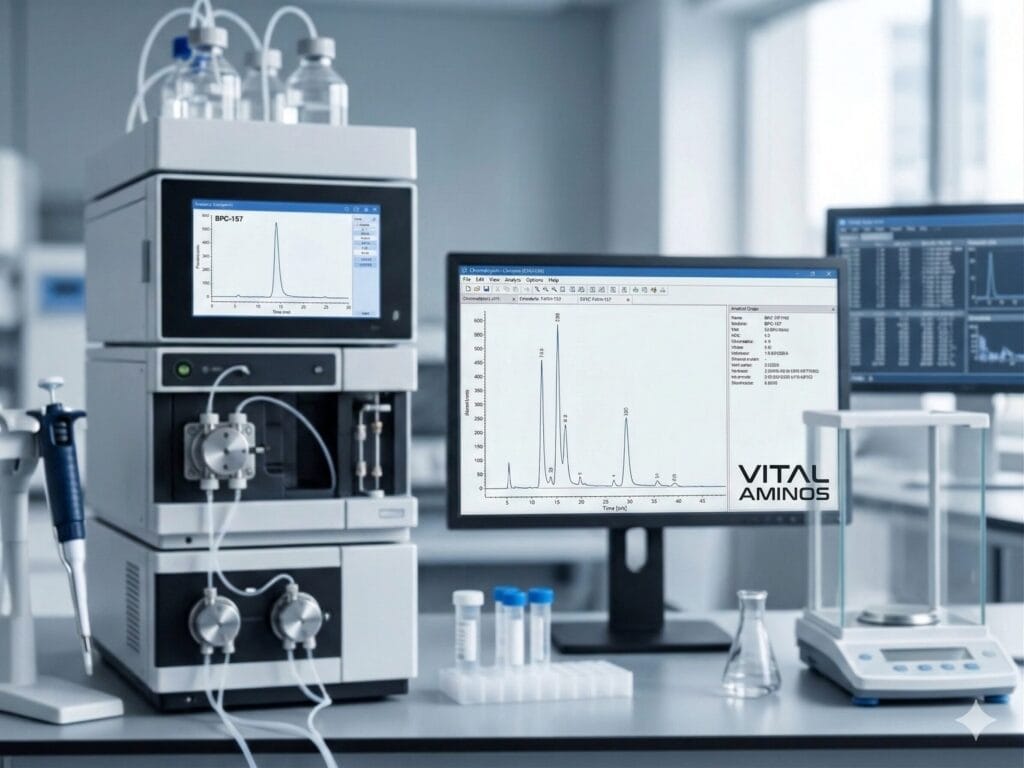
Think of HPLC as a super-powered molecular filter. It takes a sample of the peptide and separates every individual component based on its unique chemical properties.
A high-pressure pump drives the sample through a specialized column. Pure peptide molecules move at one speed, while any impurities move at different speeds. The result is a simple graph—a unique fingerprint of that vial’s contents.
How to Read an HPLC Chromatogram
An HPLC report is not just a collection of peaks and valleys. It is a precise map of purity. When you look at an analysis from Vital Aminos, here is what you need to focus on:
1. The Main Peak (Your Pure Peptide)
The most important part of the graph is the largest, steepest, and singular peak. It should represent over 99% of the total area under the curve.
- A Good Peak: Is sharp and symmetric. This means your sample contains a very high concentration of a single molecule, like [pure BPC-157].
- A Bad Peak: Is short, rounded, or lumpy. This suggests that the synthesis was imperfect or the storage conditions caused degradation.
2. The Baseline (Finding the “Ghosts”)
The flat line at the bottom of the graph is just as critical as the main peak. A truly high-purity sample will have a baseline that is near-perfectly flat.
If you see smaller “ghost peaks” or a wavy, inconsistent baseline, that’s not pure peptide. Those are the leftovers:
- TFA (Trifluoroacetic Acid): A common, often-ignored solvent from the synthesis process.
- Truncated Peptides: Molecules where the synthesis didn’t finish, leaving incomplete and unusable sequences.
Mass Spectrometry: The Final Step (Confirming the “Who”)
While HPLC confirms purity (the “how much”), Mass Spectrometry (MS) confirms identity (the “who”). It measures the precise molecular mass of the peptide.
A perfect HPLC peak means nothing if the vial contains the wrong substance. A valid MS report must show a single, clean peak that exactly matches the theoretical molecular weight of the peptide you ordered.
The Purity Standard: 99% or Zero
In the peptide synthesis world, getting to 90% purity is easy. Getting to 99%+ is difficult, expensive, and requires obsessive skill. It means multiple rounds of costly purification and rigorous testing.
When a batch tests at 99%+ purity, it doesn’t just look better on paper. For a researcher, it provides peace of mind. Your data won’t be skewed by artifacts or contaminants. At [Vital Aminos], 99% is not our goal; it is our starting point.
A Call to Authenticity: View Our Results
Don’t settle for mystery vials or an “unverifiable claim” of purity. Your research deserves better. Every batch of our peptides is independently verified by a third-party lab using the techniques described in this guide.
We invite you to view our latest third-party HPLC and MS reports for yourself. Compare them against the standard. Then, decide for yourself what true purity looks like.
Every batch of our peptides is stored in a climate-controlled environment and shipped with a commitment to transparency.
[View our BPC-157 Lab Results] | [Shop the Full Collection]