
Research Use Only
All content on this page is provided for educational and research purposes only. Vital Aminos products are sold for in vitro research and laboratory use. They are not approved for human consumption. Always consult a qualified medical professional before considering any biologically active compound.
BPC-157 and TB-500 are two of the most-discussed peptides in regenerative biology research, and they’re routinely studied together. Each peptide acts through distinct mechanisms — but the overlap in tissue-repair pathways is the reason researchers stack them. This guide covers what the peer-reviewed literature shows about combining them, including mechanism overlap, typical research protocols, dosing math, and how to verify what you’re buying.
Why researchers study BPC-157 and TB-500 together
Both peptides are small, soluble, and surprisingly stable for biologically active fragments. They reach distressed tissue through different pathways and act on different intracellular targets. In animal studies of injured tendons, ligaments, and gastrointestinal tissue, the combination has shown additive effects on:
- Angiogenesis — formation of new blood vessels at the injury site
- Fibroblast migration and proliferation — the cells that lay down new collagen
- Reduced fibrotic scarring — better tissue quality during repair
- Modulation of inflammatory cytokines — reducing chronic inflammation around the injury
This is why the stack appears so often in soft-tissue recovery research: each peptide accelerates a different phase of the repair cascade.
BPC-157: mechanism of action
BPC-157 is a 15-amino-acid sequence (pentadecapeptide) originally isolated from gastric juice. It’s gastric-stable, meaning it survives stomach acid intact — a rare property for peptides this size.
Documented mechanisms in animal research include:
- Upregulation of VEGFR2 — promotes new blood vessel growth (Hsieh et al., 2017)
- NO synthase modulation — affects vasodilation and local blood flow
- Dopaminergic and serotonergic system effects — implicated in nerve protection
- Growth hormone receptor upregulation — in tendon fibroblasts specifically (Chang et al., 2014)
For a full breakdown of BPC-157 dosing protocols and reconstitution math, see our BPC-157 Dosage Guide.
TB-500: mechanism of action
TB-500 is a synthetic 17-amino-acid fragment of Thymosin Beta-4 (TB4), a naturally occurring protein found in nearly every cell in the body. While TB4 has many roles, the fragment used in research (TB-500) is specifically the actin-binding domain — the region responsible for cellular migration.
Documented mechanisms include:
- Actin polymerization — facilitates cell migration to injury sites
- Endothelial cell migration — supports angiogenesis
- Anti-inflammatory cytokine modulation — reduces IL-6 and TNF-α in injury models
- Stem cell differentiation — particularly in cardiac and muscle tissue studies
Unlike BPC-157, TB-500 has a longer biological half-life and is generally dosed less frequently in research protocols.
The mechanism overlap (and why it matters)
The two peptides converge on three repair pathways:
- Angiogenesis — Both promote VEGF-mediated blood vessel growth. BPC-157 acts on VEGFR2 directly; TB-500 increases endothelial cell motility so vessels can form faster.
- Cell migration — Both increase fibroblast and inflammatory cell mobility, but through different mechanisms (BPC-157 via FAK/paxillin; TB-500 via actin binding).
- Inflammatory resolution — Both modulate pro-inflammatory cytokines, accelerating the transition from inflammatory to proliferative phases of tissue repair.
In Krivic et al. (2008), the combined effect on Achilles tendon healing in rats was significantly greater than either peptide alone — a key finding that drives research interest in the stack.
Research protocols for combined use
Published animal studies and observational protocols vary widely. Below are typical ranges used in peer-reviewed papers (per kg body weight, scaled to research subject).
| Peptide | Research dose range | Typical frequency |
|---|---|---|
| BPC-157 | 2.5 – 10 mcg/kg | 1–2× daily, subcutaneous |
| TB-500 | 2 – 5 mg total weekly dose | Front-loaded over first 4–6 weeks, then maintenance |
Values reflect ranges observed in cited research literature. Vital Aminos does not recommend or prescribe dosing.
Loading and maintenance phases
TB-500 protocols typically include a “loading phase” (higher weekly doses for 4–6 weeks) followed by reduced “maintenance” dosing. BPC-157 is more commonly dosed at a steady daily rate across the entire research period.
Reconstitution math: combined vials
Researchers handling both peptides simultaneously have two options:
Option 1: Two separate vials
Standard approach. Each peptide is reconstituted with bacteriostatic water in its own vial, drawn separately, and administered. This is the protocol used in most cited research.
Example reconstitution for BPC-157 10mg + TB-500 5mg:
- Add 2mL bact water to BPC-157 vial → 5,000 mcg/mL → 0.1mL = 500 mcg
- Add 2mL bact water to TB-500 vial → 2,500 mcg/mL → 0.4mL = 1,000 mcg
Option 2: Pre-blended stack
Some researchers prefer a single combined vial that contains both peptides at fixed ratios. The advantage is a single injection rather than two. The disadvantage is reduced flexibility in adjusting individual peptide doses.
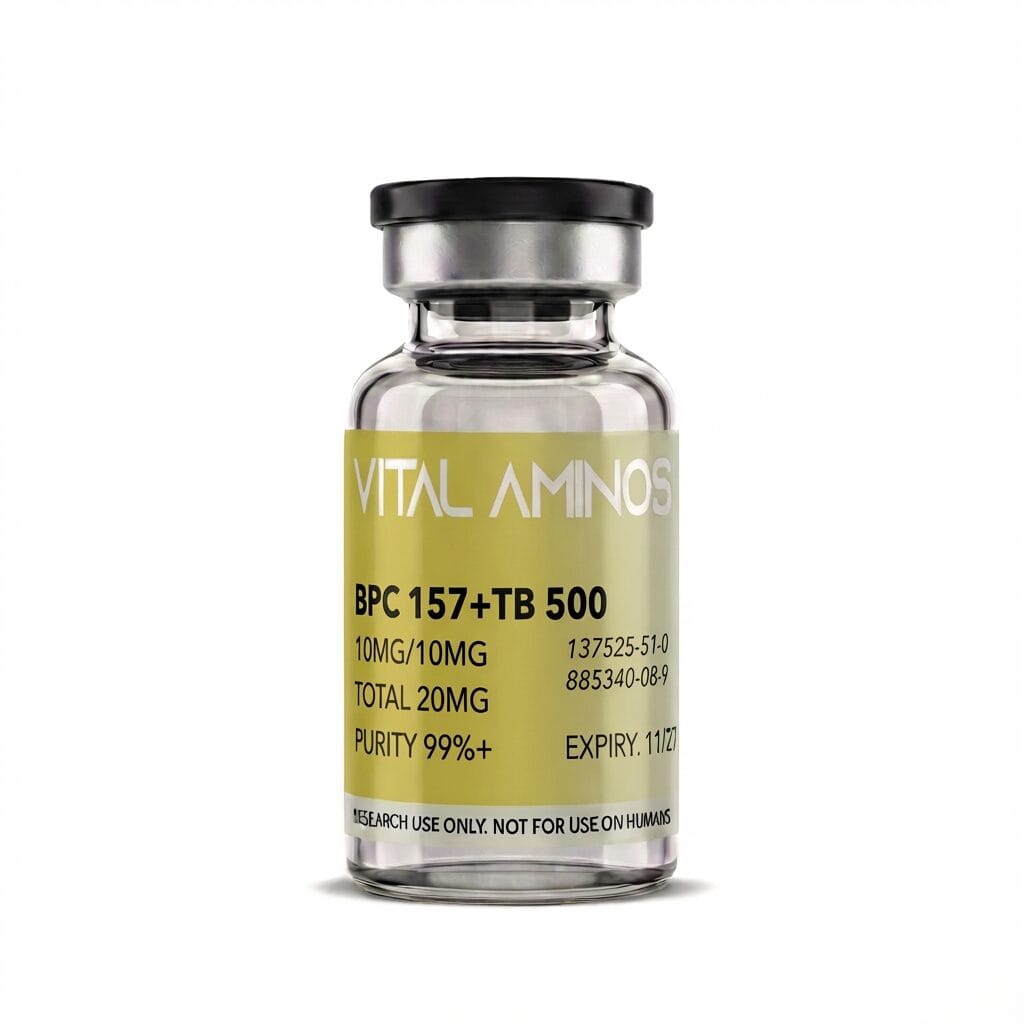
Vital Aminos offers a pre-blended BPC-157 / TB-500 stack for researchers who prefer this approach. The blend ratio simplifies reconstitution while delivering both peptides in a single injection volume.
Key research citations
- Krivic A, et al. (2008). Achilles tendon-to-bone healing accelerated by BPC-157. J Orthop Res.
- Chang CH, et al. (2014). BPC-157 effects on tendon fibroblast growth hormone receptors. J Orthop Res.
- Hsieh MJ, et al. (2017). BPC-157 promotes vasculogenesis via VEGFR2. Vasc Pharmacol.
- Goldstein AL, Hannappel E, Kleinman HK. (2005). Thymosin β4: actin-sequestering protein moonlights to repair injured tissues. Trends Mol Med.
- Sosne G, et al. (2010). Thymosin beta 4 promotes corneal wound healing. Ann N Y Acad Sci.
Side effects reported in literature
Both peptides show favorable safety profiles in published animal studies, though human clinical trial data is limited. Effects occasionally reported include:
- Mild injection site reactions (redness, transient swelling)
- Lightheadedness with high subcutaneous doses (TB-500)
- Initial fatigue during loading phase (TB-500)
No significant adverse events related to mechanism of action have been reported in the cited literature when used at typical research doses. As with all research compounds, sterile handling and proper storage are essential.
Storage best practices
- Lyophilized (powder): Stable at room temperature for shipping; refrigerate (2–8°C) for long-term storage.
- Reconstituted: Refrigerate immediately. Use within 28 days for BPC-157 and within 30 days for TB-500. Do not freeze reconstituted peptide.
- Light sensitivity: Store in original glass vial, away from direct light.
Where to source verified BPC-157 and TB-500
The peptide market is full of products that fail purity testing. Before purchasing, verify three things:
- HPLC purity ≥99% on the specific batch — not a generic “purity statement”
- Independent third-party lab — not in-house testing
- Current COA — within 6 months of synthesis
Every Vital Aminos batch is HPLC-tested at a third-party lab. View our complete lab report library to see the COA for any product in stock.
Available individually
- BPC-157 10MG — standard 10mg lyophilized vial
- TB-500 5MG — see our shop for current TB-500 listings
Available as a stack
- BPC-157 / TB-500 Pre-Blended Stack — single vial for combined research protocols
- Healing and Repair Bundle — full stack with GHK-Cu added for tissue research
FAQ
Is BPC-157 + TB-500 the most-studied peptide stack?
It’s one of the most-cited combinations in tissue-repair research, particularly for tendon, ligament, and gastric injury models. The combination appears in dozens of peer-reviewed papers and observational protocols.
What’s the half-life of each peptide?
BPC-157 has a relatively short half-life (estimated 4 hours in plasma), which is why daily or twice-daily dosing is typical. TB-500 has a much longer effective half-life due to its tissue retention — twice-weekly dosing is common in research.
Why does TB-500 have a “loading phase”?
The loading phase establishes a tissue concentration of the peptide. Because TB-500 acts on actin-sequestration intracellularly, building up cellular concentration during the first 4–6 weeks appears to drive faster repair in animal studies. After the loading phase, lower maintenance doses sustain the effect.
Can these be used in oral form?
BPC-157 has limited oral bioavailability data (it is gastric-stable, which is the basis of some oral protocols). TB-500 has essentially no oral bioavailability data in published research — it’s studied almost exclusively via subcutaneous injection.
Where can I read more about how to verify peptide purity?
See our Lab Reports page for a full breakdown of what HPLC analysis tests for and how to interpret a peptide certificate of analysis.
This article is for research and educational purposes only. Vital Aminos products are sold for in vitro research and laboratory use. Always consult primary peer-reviewed research and a qualified professional before drawing conclusions about any biologically active compound.